Have any questions? Get in touch. +44 7460 829 701 info@trackandtrail.uk
Have any questions? Get in touch. +44 7460 829 701 info@trackandtrail.uk
Expedition Equipment

Load Carrying Systems
A Sherpa in the Himalayas... You would not want to be one of these!!
A rucksack is the most important part of your hiking, trekking, or expedition equipment because it carries everything you need to stay safe, comfortable, and self-sufficient on the trail. From water, food, and clothing to navigation tools and emergency supplies, all essential gear depends on a reliable pack. A well-designed rucksack distributes weight evenly across the body, reducing fatigue and preventing injury, especially on long hikes. Without a comfortable and durable rucksack, even the best equipment becomes difficult to manage, making your overall hiking experience less efficient and far more demanding.

When choosing a rucksack for trekking, prioritise comfort, fit, and capacity. Ensure the pack sits well on your hips and shoulders - a properly fitted hip belt should carry most of the weight to reduce strain. Choose a size based on the length of your trek (e.g., 25–35L for day hikes, 60–80L for multi-day treks). Look for features like adjustable suspension, padded straps, ventilation, rain cover compatibility, and accessible pockets. Durable, lightweight materials and a design that balances organisation with ease of use will make your trekking experience more enjoyable.
We recommend the Lowe Alpine AirZone Pro range. We use 65-80L, 35-45L and 25L sizes to suit the situation. The AirZone range uses a mesh frame to keep the main pack off of your back to allow air to circulate. We've used a lot of rucksacks and bergens in our time; this is the most comfortable design ever!! For larger loads we use the Lowe Alpine Cerro Torre 100-120L (2020 version). This rucksack is for loads up to 50kg!

Did you know? A properly fitted trekking rucksack transfers most of the weight to your hips, not your shoulders, reducing fatigue and back strain. Adjustable features like the hip belt and load lifters improve balance and comfort, making long treks safer and more enjoyable.
"A poorly fitted rucksack can turn a beautiful hike into a long argument with your back and shoulders"
So, what goes in it?


For a multi-day hike, your rucksack should carry everything needed for safety, comfort, and self-sufficiency while keeping weight manageable. Here’s a clear breakdown of the essentials:
Shelter & Sleep
-
Tent, shelter sheet, or bivy bag
-
Sleeping bag (rated for expected temperatures)
-
Sleeping mat or pad
Clothing
-
Moisture-wicking base layers
-
Insulating layer (fleece/down jacket)
-
Waterproof jacket and trousers
-
Spare socks and underwear
-
Hat, gloves, and sun protection
Food & Cooking
-
High-energy food and snacks
-
Stove, fuel, and lighter/matches
-
Cooking pot, mug, and utensils
-
Water bottles or hydration bladder
-
Water filter or purification tablets
Navigation & Safety
-
Map and compass
-
First aid kit
-
Headtorch with spare batteries
-
Trekking poles (recommended)
-
Emergency whistle
-
Multi-tool
Personal & Miscellaneous
-
Toiletries and toilet paper
-
Sunscreen and insect repellent
-
Phone and power bank
-
Rubbish bags
How to pack it all in
Packing efficiently and choosing lightweight, multi-use items will help keep your load balanced and perfectly comfortable over several days on the trail. When packing a rucksack, correct weight distribution and easy access are essential for comfort and efficiency on the move. Heavier items such as food, cooking equipment, and water should be packed close to your back and centered between your shoulders to keep the load stable and reduce strain. Lighter, bulkier items like clothing or a sleeping bag work best lower down or toward the outside of the pack, where they help balance the weight without pulling you backward. Frequently used items such as a waterproof jacket, map, snacks, or first-aid kit - should be placed near the top or in external pockets so they can be reached quickly without unpacking everything. Thoughtful packing not only improves balance and posture but also saves time and energy throughout the journey... Now let's go through it all in detail.
Shelter Systems
Geodesic Backpacking Tents: strength, stability, and serious shelter. When you’re heading into the wilderness your shelter isn’t just a place to sleep - it’s your protection against wind, rain, snow, and fatigue. Among the many tent styles available today, geodesic backpacking tents stand out for one reason above all: exceptional stability in harsh conditions. Designed for demanding environments, these tents are favoured by mountaineers, wild campers, and long-distance backpackers who prioritize strength over ultralight minimalism. But what exactly makes a tent “geodesic,” and why might it be the right choice for your next expedition?
What Is a Geodesic Tent?
A geodesic tent uses a framework of intersecting poles that cross multiple times, creating a web-like structure over the canopy. Unlike simple dome tents, which often rely on two poles crossing once, geodesic tents distribute stress across many points. This design forms a self-supporting, freestanding structure that resists deformation when exposed to strong wind, snow load, or uneven terrain. The more pole intersections a tent has, the stronger and more stable it becomes.
There’s also a related design called a semi-geodesic tent, which uses fewer pole crossings to save weight while still offering improved stability over standard domes. Whatever you choose, leave pop-ups for Glastonbury!!
Why Backpackers Choose Geodesic Tents
1. Superior Wind Resistance
The biggest advantage of a geodesic tent is its ability to handle high winds. The multiple pole intersections prevent the fabric from collapsing or flapping violently. This makes geodesic tents ideal for exposed ridges, alpine zones, and storm-prone environments.
2. Snow Load Capability
For winter backpacking or high-altitude travel, snow accumulation can crush weaker tents. Geodesic designs spread the load evenly, helping the tent keep its shape even when snow piles up overnight.
3. Freestanding Flexibility
Most geodesic tents are fully freestanding, meaning they don’t rely on stakes to hold their shape. This is extremely useful on rocky, sandy, or frozen ground where staking is difficult or impossible.
4. Long-Term Durability
Because stress is shared across the entire frame, individual poles and fabrics experience less strain. Over time, this translates into a tent that lasts longer under repeated harsh use.
Weight vs Strength Trade-Off
The main downside of geodesic backpacking tents is weight. More poles and reinforcements mean more to carry. While ultra-lightweight hikers might prefer trekking-pole shelters or minimalist tunnels, geodesic tents appeal to those who value reliability over shaving every ounce.
Modern materials - like DAC aluminium poles and ripstop nylon fabrics - have helped reduce this weight penalty, but geodesic tents are still typically heavier than simple two-pole designs.
If your trips involve fairweather trails and short distances, a lighter tent may be enough. But if you’re heading into unpredictable climates, the extra weight of a geodesic tent becomes a form of insurance.
Interior Space and Comfort
Geodesic tents tend to offer excellent interior volume. The rigid pole architecture creates steeper walls and more usable headroom. This is especially noticeable during long trips in the winter where you may need to shelter inside out of storms for quite some time.
Many models also include:
-
Dual vestibules for gear storage
-
Multiple vents to control condensation
-
Strong bathtub floors for water protection
Because they hold their shape so well, doors
and zips also operate more smoothly under
tension compared to sagging shelters.
Who Should Use a Geodesic Backpacking Tent?
Geodesic tents are best suited for:
-
Alpinists
-
Winter campers
-
Mountaineers
-
Wild campers
-
Expeditionists
-
Anyone camping in exposed terrain
If your adventures include snow, high wind, rocky campsites, or multi-day bad weather, a geodesic tent can dramatically improve safety and comfort. They may be overkill for casual summer hiking, but they shine when conditions are uncertain.
Key Features to Look For
When shopping for a geodesic backpacking tent, consider:
-
Waterproofness (measured by hydrostatic head - see waterproof clothing)
-
Pole material (DAC aluminium is common and strong)
-
Number of intersections (more crossings = more stability)
-
Season rating (3-season vs 4-season)
-
Ventilation design
-
Vestibule space
-
Packed weight vs trail weight
A true 4-season geodesic tent will usually have heavier fabric of 8000 HH standard, stronger poles, and fewer mesh panels to retain warmth. Although we use Hilleberg tents for serious expeditions, these are very expensive so we recommend the Berghaus range of tents for value and performance. Paticularly the Grampian, Brecon, and Cairngorm. Unless you are ultra-lightweight camping, choose a tent sized for one extra man to allow yourself some decent space for gear. It also means that if someone else has a problem with their tent, you have room (literally) to step in and help them out. For ultra-lightweight camping we use the SnugPak Ionosphere one man bivvy, but ultra-lightweight hiking is a whole subject of its own.
Final Thoughts on Tents
Geodesic backpacking tents represent the engineering design excellence of outdoor shelter. They are built not just for comfort, but for survival in tough environments. You can put them up single-handed in less than 5 minutes. While they cost more and weigh more than minimalist options, what you gain is confidence - confidence that your shelter won’t fail when the weather turns hostile, and that's exactly what you want. For backpackers who travel beyond fair-weather trails, a geodesic tent isn’t just gear. It’s a dependable partner.
Sleeping Systems
A state-of-the-art geodesic tent will be provided for you (but you will have to carry it), so let's move on to the next most important thing: your sleeping system, which you will need to provide yourself. A good sleeping system is essential for trekking because it ensures proper rest and recovery after long, physically demanding days on the trail. Quality sleep helps maintain energy levels, improves decision-making, and reduces the risk of injury or illness. An effective sleeping system - made up of a suitable sleeping bag, mat, and sleeping bag cover, provides insulation from cold ground, protection from the elements, and overall comfort. Without adequate sleep, fatigue can quickly build up, making trekking more difficult and less enjoyable.
We use and recommend, the SnugPak Softie Combo two-bag system. The SnugPak Softie Merlin 3 is a summer bag designed to fit inside the Softie Harrier 10, which is a 3-Season bag with internal anchor points for the Merlin 3. When the bags are used together like this, it should keep you warm at sub-zero temperatures.


For sleeping mats, we recommend the Thermarest Neoair Xlite NXT sleeping pad. It provides excellent insulation and padding, packs up into a very neat package, and fits inside a rucksack. Much better than the traditional roll up Karrimat, and no huge, unsightly lump of foam hanging off a rucksack.
Clothing
This subject deserves its own page, so hop over to the clothing page using the menu buttons, or CLICK HERE
Food & Cooking
Food has its own page too CLICK HERE, So let's move straight on and look at camp and field cooking equipment. Expedition cooking equipment is designed to be lightweight, durable, and reliable in remote and often harsh environments where resupply and repairs are difficult. It typically includes compact stoves that can operate in extreme cold or high altitude, fuel-efficient cookware made from materials like aluminum or titanium, and versatile utensils that minimise weight while maximising function. Many systems are modular, allowing pots, windshields, and burners to nest together for easy packing. Because expeditions may face unpredictable weather and limited fuel, this equipment prioritises efficiency, stability, and ease of use, ensuring teams can safely prepare hot meals and melt snow or ice for water in demanding conditions.
Traditonal campfires are covered on the main Expeditions page CLICK HERE, so we'll move straight onto the best cookers for field use. Do not be tempted to buy cheap copies...
The Trangia System
We use and highly recommend the Trangia 25 Series. The Trangia cooking system is a highly regarded outdoor stove known for its simplicity, reliability, and efficiency, especially in challenging expedition conditions. Originating in Sweden, it uses a spirit burner that operates silently and performs well in cold, windy environments when paired with its integrated windscreen. There is also a gas burner version. The system is designed to nest together compactly, with pots, pans, and burner forming a stable unit that is easy to pack and set up. Made from lightweight yet durable materials such as aluminium or hard-anodised aluminium, the Trangia requires minimal maintenance and has no moving parts, making it a dependable choice for long trips where reliability and fuel availability are critical.

The Trangia comes with either a spirit or gas burner. We use either depending on the situation. The choice between gas and spirit burners often comes down to reliability versus simplicity.
Gas burners are prized for their high heat output, precise flame control, and fast cooking times, which are especially valuable in cold or high-altitude environments where melting snow and cooking efficiently matter. However, they rely on pressurised canisters that can be hard to source in remote regions and may perform poorly in extreme cold unless carefully managed.
Spirit burners, typically fueled by alcohol, offer a contrasting appeal: they are mechanically simple, lightweight, quiet, and can run on widely available fuels such as ethanol or methanol, making them attractive for long or remote expeditions. Their drawbacks include lower heat output, slower cooking, and limited flame control, but their robustness and ease of repair often compensate. Ultimately, expedition cooks must balance speed and control against fuel availability and dependability when choosing between gas and spirit systems.
-
COMPLETE CAMPING COOKING SYSTEM – The original Trangia Stove is designed and made in Sweden. It is a compact, lightweight cook kit perfect for all outdoor needs. Trangia stove sets can be complemented with pots and pans made from various materials, cases, multi-disc, and several other practical accessories.
-
COOK KIT FOR 3 to 4 PEOPLE – The Trangia 25-2 stove includes two saucepans sized 1.75L and 1.5L, a frying pan, a windshield (upper and lower part), spirit burner, handle and strap. A 0.9L Kettle is included
-
SPIRIT BURNER INCLUDED – Spirit burner for alcohol-based fuels. Easy to use due to its simple construction. Suitable for families, hikers, scouting groups and others who want to have a simple and functional burner.
-
ULTRALIGHTWEIGHT ALUMINIUM – The complete 25-2 cook set packs away to a compact 22cm diameter and 10.5cm high, weighing just 1.025kg. Easily portable for backpacking, expeditions, trekking, mountaineering and camping.
-
DUKE OF EDINBURGH AWARD SCHEME KIT LIST – Trangia stoves are included on the official DofE expedition equipment list
One important thing to remind you is that the Trangia cook sets come in either aluminium, or hard anodised aluminium, which is non-stick... You can guess which one we use, right?

Trangia 25-1 Spirit

Trangia 25-5 Gas
Jetboil Flash Java 1.0L

When it comes to hiking and camping, efficiency and reliability matter. This compact cooking system is designed to deliver both, combining fast performance with thoughtful safety features — all in a lightweight, packable design.
At the heart of the system is a one-step auto ignition feature. The new turn-and-click knob igniter works just like a home stove, automatically producing a cooking flame without the need for matches or lighters. The stainless steel burner ensures dependable ignition, making it easy to start cooking quickly, even in the outdoors.
Safety and comfort are built into every detail. The Safe-Touch Zones include color-coded, rubberised areas that remain cool during use. These zones provide a secure and comfortable grip while cooking, reducing the risk of accidental burns and making handling more confident and controlled.
The improved locking system adds another layer of reliability. With three locking points and visual indicators, users can clearly see and feel when the pot is securely connected to the burner. This stable connection allows for safe and efficient cooking in various outdoor conditions.
Speed is another standout feature. The system can boil half a litre of water in just two minutes, making it perfect for preparing coffee or dehydrated meals on the trail. For coffee lovers, the included silicone French press makes it easy to brew fresh coffee during hiking and camping trips, adding comfort to any adventure.
Designed with portability in mind, the entire system is compact and lightweight. The stove components, coffee press, and a 100g fuel canister conveniently pack into the one-litre cook cup to save space and keep gear organized. The bottom cup also doubles as a measuring cup or bowl, maximising functionality without adding extra weight. (JetPower fuel is sold separately.)
Whether you’re setting up camp at sunset or preparing a quick morning brew before hitting the trail, this all-in-one cooking system delivers performance, safety, and convenience in a streamlined design built for adventure, and weighs only 400g!!
Navigation & Safety
The Compact Field Cooker
Anyone with military experience is going to be well aquainted with the BCB Fire Dragon Field Cooker System. The BCB Fire Dragon Folding Cooker is a compact, lightweight field cooking stove designed for outdoor and military use, optimised to burn BCB’s own Fire Dragon solid fuel blocks as well as other solid, gel or some liquid fuels. It features a simple folding design with retractable side walls and an integrated fuel receiver that directs heat efficiently toward your cookware, and it can even stow multiple fuel blocks inside when folded for transport. This stove is valued for its ease of use, low weight, and low cost, making it ideal for backpacking, bushcraft, or survival kits where minimal bulk matters, and it has been adopted in most British military issue setups. When paired with Fire Dragon fuel, the system can quickly bring water to a boil while burning cleanly and leaving little soot, and its sturdy but simple construction makes it a reliable choice for heating meals or drinks in the field.

It's ideal for solo ultra-lighweight camping, but not for group expeditions unless everyone is expected to carry one for their own use. Individual cooking is not recommended on an expedition as it discourages team spirit... Yeah, but we admit to always carrying one of these anyway, just in case we need a quick brew out on the hills.


Electronic Navigation Devices
We encourage the use of map and compass instead of GPS and electronic navigation devices because maps build real understanding, reliability, and self-sufficiency in the outdoors. A map and compass teach users how to read terrain, recognise landmarks, and think critically about where they are and where they’re going, rather than simply following a screen. Unlike electronics, they don’t rely on batteries, signals, or software that can fail in cold, wet, remote, or emergency conditions. Learning these traditional skills increases situational awareness, confidence, and safety, ensuring that people can navigate effectively even when technology is unavailable or unreliable. Ultimately, map and compass use develops stronger decision-making and a deeper connection to the environment.
However...
Where safety and security are concerned, we cut no corners, so
we do carry the Garmin InReach Mini 2 which is a lightweight
and compact Satellite Communicator, hiking handheld, with
two-way messaging, interactive SOS alerts, location sharing,
global satellite networked in a rugged submersible design.
This allows us to send instant distress calls giving our exact
location at the touch of a button. Team members and family
can also track us from afar using the web interface, and
communicate with us via SMS text messaging even when we
are far from a mobile signal - anywhere in the world.
Shown here with the rucksack shoulder strap mount which makes
the perfect combination for rapid accessibility and signal reception.
The Map
Whilst there are a number of map makers out there, we always use Ordnance Survey, aka OS maps. We've been using them for too many years, and since familiarity is extremely important, frankly, we don't see a good case for using anything else. OS maps come in a variety of scales, the most common being 1:50,000 (Landranger Series), 1:25,000 (Explorer Series), and 1:10,000. If you are travelling over long distances, the 1:50,000 is a good scale to use. For normal expeditions, we recommend 1:25,000, although we usually carry both. The military uses 1:25,000 and 1:10,000. The 1:10,000 shows an incredible amount of detail, but because of the large scale, only over a small area on each sheet. Practical for operational planning, but not for trekking.
Did you know? Ordnance Survey maps are so detailed that they show more than 500,000,000, that's half a billion individual features across Great Britain – from roads and rivers to buildings, footpaths, and even stone walls (you have to wonder who counted them). The organisation was founded in 1791 to help defend the country. Today its maps are trusted by walkers, emergency services, and scientists for their incredible accuracy.
"I'm never lost, but quite often find myself somewhere unexpected"
1:25,000 OS maps show a great amount of detail too, certainly enough for us in everyday trekking. Simple features like field boundaries, which don't show on a 1:50,000, can be of great benefit in navigating accurately across land, and for relocating (the practice of determining exactly where you are on the map and ground). Land Navigation techniques are beyond the scope of this website, but they are something we teach at Track & Trail. If you are interested in learning how to navigate and map read to an advanced level, get in touch with us via the Contact page, or CLICK HERE.
As well as the Landranger and Explorer series, Ordnance Survey also produces 1:25,000 scale maps in the Explorer Active series, which are waterproofed. This makes them slightly bulkier and a little more difficult to fold, but we highly recommend them. This is what we use, although you will need two 1:25,000 maps to cover the same ground as a 1:50,000 as illustrated here.
Of course, you could always use Maps on phones and GPS systems, but this is not what Track & Trail are about. One day, probably when you're in the middle of nowhere, electronic navigation sources will fail you. In times of war, for instance, GPS systems will be altered, encrypted, or just switched off (the miltary use different systems which are not accessible by civilians). You may suddenly find your device positioning you in another part of the world. A physical map and a magnetic compass will not let you down, as long as you know how to use them.
Always be sure you have the latest edition of the map/s you need. Maps show natural and man-made features which are critical to accurate land navigation and relocation, all of which change perhaps more frequently than you realise. Remember: the definition of a map is a bird's eye view of the ground, drawn to scale, showing natural and man-made features. These features are all dynamic. New roads will be built, tracks will disappear, whole forests will be felled, I could go on... Although no one's managed to move a mountain yet.
The Lightweight Compass


Like anything, there are people who make magnetic compasses, and then there are people who really make magnetic compasses! Suunto and Silva are at the top, and Silva get our vote always, because they're excellent, and because, like OS maps, we've been using them for a long time. Familiarity doesn't always breed contempt!
We recommend the Silva Expedition Neo, expensive and strangely difficult to obtain in the UK, but it has technology which resists demagnetisation even more than the standard Silva range does. If you don't want to spend that sort of money, the Silva Ranger series will be perfectly adequate. You will need a bezel marked in Degrees for civilian use, but one marked in Mils (miliradians) for military use. Don't be tempted to buy one marked with both (they are available but don't), because one or other of the scales will be virtually unreadable and confusing. Below is the anatomy of a basic Ranger compass. Other models will have romers for different scale maps, and other features, but the features labelled on this model are adequate for most treks.

Compare this to the Silva Expedition Neo, below, and you will see the extra features on the base plate and a facility to lock in current declination... We won't explain that here, because, like map reading, that is beyond the scope of this website, but use the Contact page if you would like to learn more. It also has a feature to measure inclination, which is useful for measuring hill gradients. Why would we want to do that? Well we wouldn't, we can see how bl***y steep it is, but it sounds cool.

First Aid Kits
The first thing to know is that your Expedition Leader and Support Team will have a comprehensive First Aid Kit with them, and are trained to use it. All you need is a small personal kit, and these are readily availabe from many sources. We recommend the LifeSystems range, As leaders, we carry a small personal first aid kit as well as a much larger one designed for the group. The personal ones are for us. The larger one is for anyone else... If that were not obvious. This is a good one for you, not only because it's got TREK written on it!


A personal first aid kit should include basic supplies to treat minor injuries and manage common emergencies. Essential items are adhesive bandages in various sizes, sterile gauze pads, medical tape, antiseptic wipes, and antibiotic ointment to clean and protect wounds. It’s also useful to include pain relievers, blister treatment, tweezers, small scissors, disposable gloves, and any personal medications. Keeping these items organised in a compact, waterproof container ensures quick access when needed.
Did you know? Keeping just 3 Jelly Babies in your first aid kit could save a diabetic's life. An EpiPen is another life saver. But be warned: offer it to the patient to administer themselves unless they are beyond doing so, in which case you can normally be forgiven for assuming implied consent to saving their life. People now have the right to an expressed wish not to be resuscitated respected. If this is known, your duty is to keep them comfortable but not attempt resuscitation; no matter how difficult that may feel for you. It's complicated, so get yourself on a First Aid course as soon as you can, even if it's just a basic one to begin with. That aside, the watchwords are: Preserve Life and Promote Recovery — but don't become a casualty yourself in doing so.
Headtorches
We recommend Petzl headtorches because they stand out as the best in their class. They combine exceptional reliability, intelligent design, and cutting-edge lighting technology. Trusted by climbers, runners, rescue teams, and outdoor professionals worldwide, Petzl headtorches are built to perform in demanding conditions where failure isn’t an option. Their powerful, well-balanced beams provide excellent visibility without sacrificing battery efficiency, while features like reactive lighting, waterproof construction, and comfortable, secure headbands make them practical for long, intense use. With a strong focus on safety, durability, and user comfort, Petzl consistently delivers headtorches that outperform competitors and set the standard for hands-free lighting.

As long as you promise not to bring your ukulele with you, we'll get on fine! The Petzl Actick Core headtorch is a great choice. It's an ideal rechargeable headlamp to extend your dynamic outdoor activities. Casting 625 lumens, the ACTIK CORE provides powerful and comfortable lighting to go with you when you’re running, trekking, or mountaineering. Its phosphorescent reflector makes it easy to find in the dark. Red lighting keeps you from blinding those around you and a reflective headband allows you to remain visible. The ACTIK CORE comes with the CORE rechargeable battery and also works with three standard batteries, with its HYBRID CONCEPT design.
FEATURES
Lightweight, powerful, and rechargeable headlamp:
-
625 lumens and only 88 g
-
Easy to charge via USB-C port (charging cable not included)
Versatile and comfortable lighting for movement and dynamic activities:
-
Wide, uniform beam so you can comfortably see up-close or around your feet
-
Mixed beam (wide and focused) allows for proximity and distance vision for movement
-
Three white lighting levels: MAX BURN TIME, STANDARD (better power/burn time balance), and MAX POWER
-
Continuous red lighting to preserve night vision without blinding those around you, and strobe to signal your location, especially in emergency situations

However, at the top of the range is the Petzl Swift RL. This what we use. It's a high-performance, rechargeable headtorch that impresses with its blend of power, intelligence and ease of use. Delivering up to 1,100 lumens of brightness in a compact ~100 g package, it’s built around Petzl’s REACTIVE LIGHTING® technology, which uses an integrated sensor to automatically adjust brightness and beam pattern to match ambient light and user needs, helping extend battery life and reduce manual adjustments. The mixed beam provides both wide and focused illumination for working or moving in varied environments, while multiple lighting levels and red light options preserve night vision or signal your presence. Rechargeable via USB-C with a removable battery, it also features an ergonomic reflective headband, single-button control, and a lock function to prevent accidental activation, making it a versatile choice for outdoor activities, running and professional use alike. But at around £100, you wouldn't want to lose it!!


You can also get a little case, the Petzl Noctlight (on the right not to scale) that diffuses the light from the Swift RL and turns it into a handy tent light when hung from the roof frame. You can operate the headtorch through the case. Great idea. We use these too.
Emergency Backup
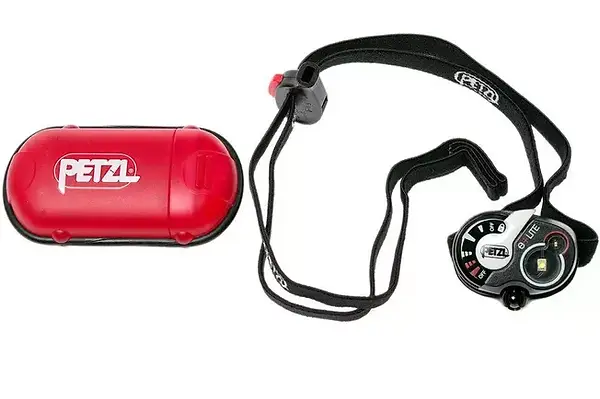
The Petzl e LITE E02P4 head torch is ultra compact, with a weight of only 26 grams. The ideal addition to any emergency kit. This e LITE can withstand extreme temperatures from -20°C to 60°C, has an emergency whistle, and comes with a 10-year guarantee of usability. This means that the head torch can be stored unused for up to ten years and will still be ready to use. As soon as you are finished with the head torch, put it in the lock, so you don't run the risk of the light switching on accidentally and the battery running empty. You can choose between red and white light. Red light is perfect for maintaining your night vision. This head torch is intended to save you in an emergency situation.
The e LITE also meets the IPX7 standard. This means the head torch is waterproof. You can wear it carefree in the rain, and even if you want to submerge it in the water, that's no problem either. The torch works perfectly in rain showers or snow. It can also be tilted into several positions. Handy if you want illumination at a certain angle.The e LITE provides enough light to easily illuminate your immediate surroundings and also make you clearly visible. The multifunctional elastic allows you to wear the torch on your head, around your wrist or around your neck. There is a clip on the back of the e LITE E02P4, so you can easily attach it to a backpack or jacket pocket, for example.
It offers three white light levels and two red LED modes: steady or flashing mode. You can adjust this instantly via the slider, dependent on the situation. The torch starts in the least bright light mode. After going through all the light modes, the torch turns off.
White light modes
High: 40 lumens, burn time approx. 3.5 hours
Standard: 20 lumens, burn time approx. 9.5 hours
Strobe: 15 lumens, visible at 100 metres for 95 hours
Red light modes
Low: 2 lumens, burn time approx. 15 hours
Strobe: 2 lumens, visible at 100 metres for 70 hours
The e LITE comes with two CR2032 batteries, a head band and a protective cover.
Trekking Poles
Trekking poles are a valuable piece of gear because they improve balance, reduce strain on the body, and increase overall hiking efficiency. By distributing some of the workload from the legs to the arms, trekking poles help lessen impact on the knees and joints, especially during steep descents or long treks. They also provide added stability on uneven terrain, such as rocky paths, muddy trails, or river crossings, which can help prevent slips and falls. In addition, trekking poles encourage better posture and rhythm while walking, allowing hikers to maintain a steady pace and conserve energy over longer distances. You will be taught how to use them properly... Most people don't even realise there is a proper way to use them!

They can also be used in emergency situations to assist someone if they've injured themselves, as a crutch or as splints. We recommend LEKI Makalu Cork Lite, which are extremely comfortable with good grip, not too springy, and very strong. Leki trekking poles stand out as the best because they combine precision engineering, durability, and thoughtful design in a way few competitors can match.
Known for their German craftsmanship, Leki uses high-quality materials like aircraft-grade aluminum and carbon fiber to deliver poles that are both lightweight and exceptionally strong. Their industry-leading locking systems—such as Speed Lock and Super Lock—are reliable, easy to adjust on the move, and trusted in demanding alpine conditions. Ergonomic grips, interchangeable baskets and tips, and excellent vibration control make Leki poles comfortable and versatile across everything from steep mountain ascents to long-distance hikes. When reliability, performance, and long-term value matter, Leki consistently sets the benchmark by which all others are measured.
Water Filtration Systems
Water is not always available on tap. To avoid carrying gallons of the stuff, invest in a top quality filtration system. Use water from fast flowing sources on hills and mountains, NOT lakes, reservoirs, or rivers. We use the Sawyer, Cnoc combination. You don't have to hang it from trekking poles, the bag is designed to be very quickly squeeze-flowed straight into your bottle.
Lightweight and, easy-to-use the filter removes harmful bacteria, protozoa, cysts, sediment and 100% microplastics; Perfect for outdoor adventures, travel or emergency preparation, the Sawyer Squeeze Filter is reusable and easy to clean, lasts up to 100,000 gallons. The fibre walls in Sawyer's hollow fibre membrane filters are thicker, making them stronger than other typical hollow fibre membranes, which allows for more rigorous rewinding.
The Cnoc 2 litre bladder is made of extra durable TPU with a wide mouth opening for quick and easy filling. The system weighs less than 6 oz and includes a cleaning clutch and cleaning piston. The bag is BPA and PVC free. Back-flush the filter when you get home.

Specialist & Technical Equipment

This website is dedicated to hiking, trekking, and expedition training. We do not provide climbing instruction in the technical sense of rock-face activities — or para-ski-jumping... We'll leave that one to . However, certain items of equipment commonly associated with climbing also have an important role in mountain walking, particularly in high, exposed, or winter conditions.
For example, the use of a helmet is strongly recommended when routes pass beneath steep or unstable faces where natural rockfall may occur, or where stones could be dislodged by walkers or climbers above. While such areas should be avoided whenever possible, alternative routes are not always available in mountainous terrain.
Similarly, crampons and ice axes are routinely used by winter walkers as well as climbers to ensure security on snow and ice. Ropes and basic hardware may also be necessary where steep descents become hazardous under certain conditions. For these reasons, we include brief introductions to this more technical equipment to inform and guide readers in its appropriate use within a hiking and trekking context.
Climbing Helmets
Choosing the best climbing helmet comes down to balancing protection, comfort, and the type of climbing you do. Start by looking for certified safety standards (such as UIAA or CE), which ensure the helmet can handle real impacts from falls or rockfall. Fit is crucial: the helmet should sit level on your head, feel snug without pressure points, and stay secure when you shake your head. Consider ventilation and weight, especially for long routes or warm conditions, since a lighter, well-ventilated helmet reduces fatigue. The shell style also matters—hard-shell helmets are durable for frequent use, while foam helmets are lighter and better for performance climbing. Finally, check adjustability and compatibility with hats or headlamps so the helmet works comfortably in the conditions you plan to walk. We use and recommend the Petzl Boreo for comfort and range of protection. When sizing, remember you may want to wear this over a beanie hat in cold weather.

Crampons & Microspikes
Crampons are essential on winter mountains because snow and ice turn normal trails into slippery, dangerous surfaces where regular boots can’t grip. As temperatures drop, packed snow hardens into ice, increasing the risk of uncontrolled slips and long falls. Crampons attach to boots with sharp metal points that bite into frozen terrain, giving climbers stability and confidence on steep slopes, icy ridges, and frozen traverses. Without them, even experienced hikers can struggle to move safely, waste energy, or be forced to turn back. In winter mountaineering, crampons are not just helpful gear—they are a critical safety tool that allows people to travel efficiently while reducing the risk of injury or rescue situations. You will need specialist winter mountain boots that are designed to accomodate them. We use and recommend Grivel and Stubai crampons and ice axes. We carry Grivel Explorer or Kahtoola microspikes where crampons are overkill... Good on wet grass too.
Ice Axe
An ice axe is a fundamental tool in winter mountaineering, used for balance, safety, and self-arrest on snow and ice. When traveling across steep or frozen slopes, the axe acts like a third point of contact, helping climbers stay stable and move with control. If a slip happens, the ice axe can be driven into the snow to stop a fall before it becomes dangerous. It’s also useful for cutting steps, probing snow conditions, and assisting with climbing short icy sections. In harsh winter environments where footing is uncertain, an ice axe isn’t just equipment—it’s a vital piece of protection that increases both confidence and survival on the mountain.
Ropes, Harnesses, Karabiners, and Figure-of-Eight Descenders
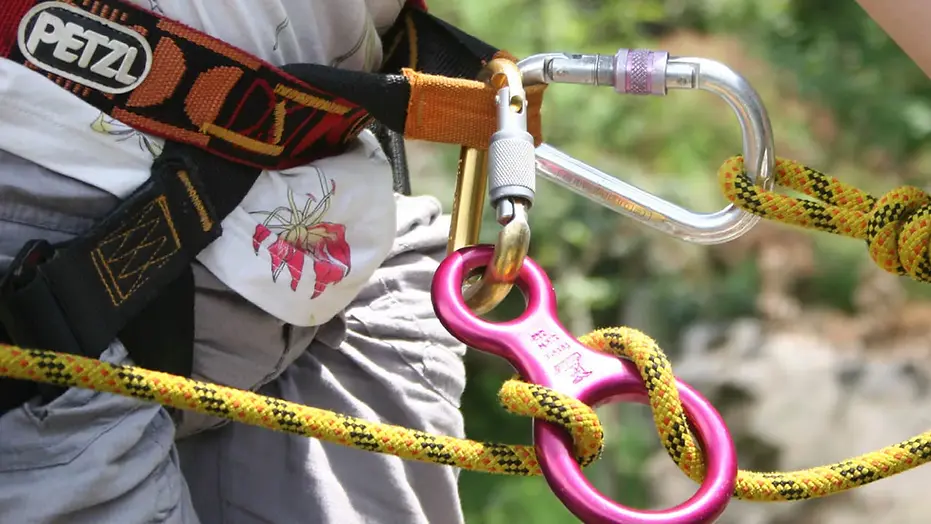
Ropes, harnesses, karabiners, and figure-of-eight descenders work together to keep climbers and walkers safe while moving on steep or exposed terrain. The rope provides the main lifeline, allowing climbers to secure themselves and protect against falls. A harness is worn around the waist and legs to attach the climber securely to the rope system or belay. Karabiners are strong metal connectors used to clip ropes to harnesses, anchors, and protection points quickly and safely. These are not the ubiquitous karabiners found in everyday life. These items have officially stamped load-bearing ratings. Be careful you buy only from reputable outlets, who should ask you what you are intending to use them for to ensure the correct selection is made. The figure-of-eight descender is used for abseiling or controlling the descent of yourself or a partner on difficult ground, creating friction on the rope so climbers and walkers can descend smoothly without losing control.
Climbing ropes and abseiling ropes are not the same. You need a bit of give in a climbing rope, whereas that's the last thing you want in an abseiling rope. Together, this equipment forms a reliable safety system that allows climbers to travel, climb, and descend mountains with much greater confidence and protection. Ropes have a defined life and useage amount. Keep a record of use, and replace when they have been used to the limit or time-expired, whichever is the sooner. Washing them in clean, clear water after each use is a good idea to get rid of any grit that can work itself into the fibres and cause premature wear. Do not dry in the sun... UV rays, and all that. Take as much care of this equipment as a parachutist would a parachute. All the ropes we use are made in England by Marlow who have been making high performance safety critical ropes for over 200 years.
Choice and use of this equipment needs very specialist training. As such, we list it here only for enlightenment. How to choose and use them safely is beyond the scope of this website, except to say, never use second-hand equipment of this nature. You need to know the exact history of all of this type of gear, be pepared to retire anything to the bin if you have used it harshly, and if we were you, we would not lend it to anyone else either.


Still writing...
We're still creating content for this page. Keep checking back. More to come...
